Monday, December 3, 2018

Give the Chanukah Present of Being Present


Have you seen this one about how to explain the Chanukah miracle in contemporary terms?


It’s funny because it’s true. 

We CAN better appreciate what it’s like to have just a little bit of fuel last for a long time through the analogy of our cell phone batteries.  Who among us doesn’t know what it’s like to be searching frantically for a charger or an outlet as the “Battery Low” message appears on the screen?

We’re spending too much time looking at our screens!

Now, screens and devices aren’t all bad.  Don’t know the answer to a question?  Google is there with an instantaneous answer.  At the same time, all of this screen time means less time for reality.

While the scientific data is still evolving, we are well aware of the negative effects of too much time spent on screens and not enough spent living in the moment.  I found it particularly ironic that when I read this article online about the subject, the pop-up ad was for a new T-Mobile phone!

That’s why I thought this initiative was very appropriate:  This Chanukah, Go Screen Free for 30”

The idea is to put away the phones and avoid screens for (at least) the first 30 minutes after kindling the Chanukah lights.  The 30 minutes comes from the minimum time the candles must remain lit to fulfill the mitzvah.  (Kudos to Ramaz for publicizing this initiative as well!)


Each night, after lighting the candles, we proclaim: "Ein lanu reshut l'hishtameish bahem ela lir'otam bilvad - we have no permission to use the candles for mundane purposes.  Their only purpose is to be watched.  How awesome would it be if the only thing we do after lighting the candles is to be fully focused on the lights of those around us?

The Talmud states:
תנו רבנן מצות חנוכה נר איש וביתו

The mitzvah of Chanukah is for there to be a light kindled for oneself and one’s household

Often, this teaching is the jumping off point for the discussion of how, while the mitzvah requires only one candle, we light more to fulfill the obligation in a more ideal fashion – mehadrin min ha-mehadrin.  I suggest we focus our attention on those three little words – near ish u’veito.  The mitzvah of Chanukah is fulfilled when we focus our attention on the family.

This can be why, even though the ideal is to place the candles where they can be seen by those outside, the Talmud concludes:

מניחה על שלחנו ודיו
            It suffices to light the Chanukah lights on the table

The best, most fundamental way, to celebrate Chanukah is to focus – really focus – on those around us, those sitting around the table.  That’s plenty.

It is not easy to set aside our connection to the wonders of the internet, Facebook, Twitter, Instagram, Snapchat, and the other portals for information.  I know from experience.  At the same time, the greatest present we can give ourselves as Chanukah ends is to try and be more present – more fully present – for all the great things going on around us.

Friday, November 23, 2018

Take Ten Seconds for Gratitude


I am not shy about loving Thanksgiving!  (See here and here.)  There is something powerful in having a day reinforce the power and importance of gratitude, which is a core value of Judaism.


Many of us are familiar with Fred Rogers.  I admit I loved watching Mister Rogers’ Neighborhood and even had one of those sweater.  The man is a real tzaddik, someone who positively impacted so many through his being our neighbor. 

In 1997, Fred Rogers received a Lifetime Achievement Emmy.  In his acceptance speech – which lasted just over a minute and a half, he provided a powerful model of gratitude and how easy and impactful it can be to spend just 10 seconds being thankful. 

Thank you. Thank you. Oh it’s a beautiful night in this neighborhood. So many people have helped me to come to this night. Some of you are here, some are far away, some are even in Heaven.

All of us have special ones who have loved us into being. Would you just take, along with me, ten seconds to think of the people who have helped you become who you are. Those who have cared about you and wanted what was best for you in life. Ten seconds of silence. I’ll watch the time.

[10 Sec Pause]

Whomever you’ve been thinking about, how pleased they must be to know the difference you feel they’ve made. You know they’re the kind of people television does well to offer our world. Special thanks to my family and friends, and to my co-workers in Public Broadcasting, Family Communications, and this Academy for encouraging me, allowing me, all these years to be your neighbor. May God be with you. Thank you very much.

Since I encountered this story and video, I have been telling everyone I know about it.  We even tried it at our family Thanksgiving table.  You know what?  Ten seconds can feel like a long time.  It has the power to bring out some very powerful memories and emotions.  We need more of that.

Try it yourself.


Tuesday, June 19, 2018

It is Inspiring When Jews Can Agree on Something


Jews disagreeing is not news.

When the entire organized Jewish community speaks with a similar voice on an important issue, THAT’s news.

In the past week, vocal opposition has been growing to the separation of families at the border. Under the policy implemented in recent months, every illegal migrant who crosses the United States border is prosecuted and detained.  Since children cannot be prosecuted with adults, they are reclassified as unaccompanied minors, separated from their parents, and taken either to mass children’s shelters or foster homes.

Numerous religious groups have opposed the policy.  In recent days, the Southern Baptist Convention and the U.S. Conference of Catholic Bishops have criticized these actions.  In the Jewish community, the Anti-Defamation League (ADL) spearheaded a letter that was signed by more than two dozen Jewish groups from across the communal spectrum. 

Breaking apart families is just plain wrong, and it is not in accordance with Jewish values.  As the Jewish communal letter states:

As Jews, we understand the plight of being an immigrant fleeing violence and oppression.  We believe that the United States is a nation of immigrants and how we treat the stranger reflects on the moral values and ideals of this nation...

Our Jewish faith demands of us concern for the stranger in our midst.  Our own people’s history as “strangers” reminds us of the many struggles faced by immigrants today and compels our commitment to an immigration system in this country that is compassionate and just.  We urge you to immediately rescind the “zero tolerance” policy and uphold the values of family unity and justice on which our nation was built.

Initially, the letter included only one Orthodox signatory - Uri L’Tzedek, The Orthodox Social Justice Movement.

What about other Orthodox organizations?  Where was the voice of my community on this matter?  This is not an issue fraught with ambiguity.  This is not a question of whether or not one supports President Trump.  This is about families.  This is about children. 

Has our community really reached a point where we can’t find common ground to speak jointly on an issue on which we feel strongly has a Jewish point of view?  Is this another manifestation of our hyper-politicized environment?  Can those who are more favorably inclined towards the Trump Administration not join in criticizing a policy which so clearly goes against our religious values?

Thankfully, it was only a matter of time.  The Orthodox Union (OU) issued a statement expressing concern regarding “any steps taken that affect families and the parent/child relationship” and reported on their raising this issue in a private meeting with Attorney General Jeff Sessions.  The next day, the OU added its name to the letter.  Yesterday, Agudath Israel of America, which represents some of the more traditional elements within the Orthodox community, added its voice of  “deep concern and disappointment over the recently adopted policy of separating the members of families who have entered the United States illegally...We implore that the policy be immediately rescinded, and that affected families be reunited.”

Neis gadol haya po - A great miracle has happened here!  The Jewish world can still unite and speak with moral clarity.

The Jewish community has spoken out together in defense of the sacredness of the family unit.  Regardless of the complexity of addressing the issue of illegal immigration in this country, it is encouraging to see Jewish communal leaders – along with thousands of individual Jews – making a unified statement on an important national issue.

How can we make the moment last?

I wish I had the magic formula.  I do think that a little more humility might help.

The issues confronting the Jewish community and the world today are complex, and our community is more diverse with very little middle ground remaining for genuine discourse.  The battle for the hearts and minds of our community - and our children - will not be won with angry pronouncements. We can be committed to our own views, but we are stronger when we include consideration and discussion with those who maintain an opposing view. Even while disagreeing on other fronts, we need to find the confidence to speak out together when we agree that Judaism has a position that adds to the public discourse.

Monday, May 14, 2018

A Second Day of Yom Yerushalayim!

Shalom from Jerusalem!  I'm here having accompanied the Ramaz 8th grade (once again) on their class trip.  I then stayed an extra day to attend the opening of the US Embassy in Jerusalem. 


From being handed a hi-tech cup of water that was generated from the air (an Israeli innovation) to the police escorting our bus to the cool swag, everyone in attendance was extremely excited and moved by the experience.  Some even came to Israel just for the day. 


Prime Minister Netanyahu exhorted the crowd, “Remember this moment!  This is history!”  When Ambassador David Friedman announced, "Welcome to the US Embassy in Jerusalem, Israel!" the crowd went wild!  It felt like a second day of Yom Yerushalayim!

Why is the opening of the embassy in Jerusalem such a big deal?
Jerusalem inspires us and gives us pride. 

Jerusalem encompasses the past, present, and future of the Jewish people.  It is the place towards which Jews have - literally and figuratively- directed their hearts for millennia.  Jerusalem is the place where we have the strongest possibility for connection with God and Judaism.  (It's like the spot where the WiFi is strongest.)
Jerusalem is the capital of Judaism and the Jewish people.  To borrow Pastor John Hagee’s term, Jerusalem is the heartbeat of Israel. 
Recognition of Jerusalem as Israel's capital and the opening of the embassy makes our heart beat faster. 

The opening of the US Embassy in Jerusalem is a moment of pride in the fact that America has taken a tangible step towards acknowledging what we know in our hearts: Jerusalem is our capital.  We know how important Jerusalem is; it’s nice to see that validated by the world’s lone superpower. 
Today’s embassy opening hasn’t made our lives easier.  At the same time, it reinforces the fact that the Jewish people and State of Israel are making progress. 
Namsich hal’ah!  Let us continue forward in our Jewish mission. 
Happy Second Day of Yom Yerushalayim!

Thursday, April 19, 2018

Keep Celebrating Israel - Like Chanukah!


Celebrating Yom Ha’atzmaut is a mitzvah!  Every Jew should rejoice over the State of Israel.

But we all know Jews.  There are the Zionists, and non-Zionists, and Religious Zionists.  To say Hallel on Yom Ha’Aztmaut or not to say Hallel?  To recite it with a beracha or without the beracha?

Let’s also factor in that Yom Ha’Atzmaut takes place during the period of the Omer, when we limit our rejoicing.  How can we sing and dance to celebrate Israel when we’re supposed to be limiting our happiness?

Celebrating Yom Ha’Atzmaut would seem to be more complicated than we think.

Wrong!

Let’s be clear.  The State of Israel is a miracle.  It behooves us to celebrate the day religiously, and that means Hallel with a beracha.

It’s really very simple.  It is just like Chanukah.

Here is what the Rambam says about Chanukah (Laws of Chanukah 3:1-3):

During the Second Temple Period, when the Greeks ruled, they issued decrees against the Jews, denying their faith, and did not permit them to engage in Torah and the commandments…And the sons of Chashmonai, the Kohanim Gedolim (High Preists), prevailed, and killed them, and saved Israel from them, and appointed a king from among the kohanim.  And Jewish sovereignty was restored for more than two hundred years, until the destruction of the Second Temple.

Chanukah was a political and military victory that restored Jewish sovereignty.  Its celebration is a religious obligation.  We light candles each night and give thanks to God by joyously saying Hallel with a beracha. 

Ba-yamim ha-heim ba-z’man ha-zeh – What happened in those days is being experienced in our own time as well.  We need to learn from the lessons of Jewish history and apply them to our own experiences.  We celebrated the miracle of Chanukah then.  Today, we have just as much of a reason to celebrate Yom Ha’Atzmaut.

To quote the late, great Rabbi Yehuda Amital of Yeshivat Har Etzion in Israel:

What better authority could we seek than the Rambam, who views the fact that Jews achieved some level of independence in their own country as one of the reasons for the holiday of Chanukah?…If those two hundred years of Jewish sovereignty give added significance to the miracle of Chanukah, then the ingathering of the exiles, which is taking place before our eyes, is surely of no less significance!

Yom Ha’Atzmaut celebrates the restoration of Jewish independence after nearly 2,000 years of exile.  That is reason to celebrate.  It is a reason to party like it’s 165 BCE!  

After the last blue and white cookie or falafel ball is eaten, let’s keep celebrating the miracle of the State of Israel.  With all of its complexity, Israel is a beacon of light illuminating our lives and the lives of Jews everywhere.

Wednesday, March 28, 2018

Catching a Glimpse of Eliyahu Ha-Navi


Did you see him?  Is he really there?

Rabbi Moshe Chagiz (Shtei HaLechem 46, early eighteenth century) writes “There is no doubt that Eliyahu the Prophet will come into every Jewish house to see the fulfillment of one commandment which is really two: Pesach and milah,” and he then goes to Heaven to advocate on behalf of the Jewish nation for the coming of the Final Redemption.  Rabbi Yechezkel Landau, the Nodeh B’Yehudah, used to “escort” Eliyahu down the steps of his house after the Seder, and the custom among Belz Chassidim is to accompany Eliyahu until the nearest shul.  Certainly sounds like Eliyahu is there.

Then where is Eliyahu? How come I can’t see him? I am sure I am not alone in not seeing him. Opening the door for Eliyahu and welcoming him to the Seder is a custom that transcends geographical origins and level of observance.  Everybody knows this one.  What are we to make of, as one writer calls him, this perennial Passover no-show?

We don’t need to actually see Eliyahu.  We need to understand his message of Judaism remaining relevant from one generation to the next. 

When the Talmud poses a question which is not resolved, the conclusion is sometimes “teiku,” which stands for tishbi yetareitz kushyot v’abayot – We will only resolve the issue when Eliyahu the Tishbite provides an answer in messianic times.  Why should we turn to Eliyahu in messianic times?  Thanks to the promised resurrection of the dead, won’t there be other Jewish greats to ask – maybe Moshe or one of the Talmudic giants? 

Rabbi Levi Yitzchak of Berditchev explains that it is Eliyahu who remains more relevant than any other Jewish hero.  Moshe died and went to the next world, never to be heard from since.  Eliyahu ascended to heaven in a whirlwind. (II Kings 2:11)  Eliyahu never died, and he remains “in touch” with us until today.  He “attends” every bris ceremony, at which we give him a special chair.  He makes an appearance on Saturday nights and is part of the traditional liturgy recited by many.  And Eliyahu makes it to every Seder on Pesach.  Eliyahu can answer the questions better than anyone else since he has maintained the greatest connection with Jews throughout history.

Eliyahu bridges the generation gap.  Eliyahu represents the ability of Judaism to remain relevant from one generation to the next.

וְהֵשִׁ֤יב לֵב־אָבוֹת֙ עַל־בָּנִ֔ים וְלֵ֥ב בָּנִ֖ים עַל־אֲבוֹתָ֑ם

Eliyahu will reconcile parents with children and children with their parents…(Malachi 3:24)

Parents and children often see things differently and don’t speak the same language.  We often witness the weakening of familial or traditional bonds from one generation to the next.  Eliyahu reminds us – and encourages us – to bridge that gap.

Parents should understand that the next generation is being brought up in a vastly changed world with very different technological and social norms.

Children should appreciate the value of being the next chapter in a story that goes back thousands of years and assume responsibility for carrying the traditions forward.

When we open our doors for Eliyahu, we may not see him physically, but we encounter something far more meaningful: an approach to redeeming the Jewish present and ensuring the future.

Thursday, March 1, 2018

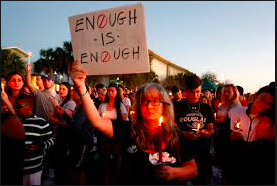
Pondering Parkland on Purim


It’s the new normal. It can’t be the new normal.

The shooting in Parkland two weeks ago continues to pain so many - and has forever impacted the lives of the families of those killed or wounded as well as all who survived the ordeal. On the one hand, we have seen this story before. There have already been 36 mass shooting incidents in 2018 - 6 since Parkland. On the other hand, the murder of students and teachers - or anyone - must shake each of us to the core. How can we become “accustomed” to these horrific acts of violence? How can we not feel the pain? Yet, the cycle continues.

In the aftermath of the shooting, the responses are similar. There is an outpouring of love, thoughts, and prayers. And there is criticism for “only” sending thoughts and prayers without actually DOING something about this crisis. (As a religious person, I’m a big of fan of both love and prayers.) There are calls to pass gun control laws - ban assault weapons and bump stocks, raise the minimum age to purchase guns, introduce stricter background checks, and be more proactive to assist those who are mentally ill and ensure they don’t have access to guns. There are the competing calls that “guns don’t kill people; people kill people” and that the second amendment is sacrosanct, so the solution to this problem must lay elsewhere.

I cannot imagine a genuine solution that doesn’t involve stricter gun laws, selling fewer guns to private citizens that have less destructive power, and being more careful who gets hold of weapons that can kill. Fewer guns means fewer people will be killed. I realize that, considering the political climate today, that it is not likely to happen so quickly. (Although I did think that Bret Stephens’ radical approach to takling this issue - repealing the second amendment and starting from scratch - would be an interesting way to reframe the conversation.)

If we’re not going to change the gun situation, what can we change? Let’s examine and the society in which we live.

President Trump made one comment in the aftermath of the Parkland shooting that caught my attention and resonated.

“Create a culture in our country that embraces the dignity of life.”

It would seem to be an obvious and self-evident value in society that all would embrace. It seems, however, to be under assault. Our society is far more fragile than it used to be with some fundamental values under assault.

There has been a familial and cultural revolution. Children are being raised differently - often with less supervision, guidance, or positive role models than they used to be. There has been a technological revolution with the internet playing an outsized role in shaping our lives. From social media to violent or vacuuos video games to an information overload that fills our heads with all sorts of unnecessary thoughts, our influences are no longer as wholesome or positive as they were - even a few years ago.

In addition, people are far less connected than they used to be.  In Bowling Alone, the sociologist Robert Putnam found that Americans are joining fewer civic organizations, socialized with friends less frequently, and signed fewer petitions.  Putnam concluded that the United States was bleeding social capital, and therefore democratic values.

Our society lacks a sense of connection. In Judaism, responsibility is a core value. As the Midrash states, we’re all in the same boat so no one person can drill a hole under his/her own seat without sinking everyone. Especially in the aftermath of Parkland, our core problem is relational. David Brooks summarizes our ills quite well: “the decline of social trust, the breakdown of family life, the polarization of national life, the spread of tribal mentalities, the rise of narcissism, the decline of social capital, the rising alienation from institutions or the decline of citizenship and neighborliness.”

Feeling more connected can make a big difference. Besides it being wonderful to have good neighbors (right, Mr. Rogers?), having strong social ties may produce more resilient neighborhoods and even help reduce gun violence.

In the aftermath of Parkland, many voices proclaimed that America should learn from Israel to eliminate such massacres. Haviv Rettig Gur convincingly challenges this view. He says gun control laws in Israel have a lot less to do with preventing school shootings than does the fact that “Israeli Jews maintain a deep and abiding faith in their shared fate and communal solidarity.”

This makes a lot of sense - especially on Purim. Shared faith and communal solidarity is very much part of the holiday.


When Esther agrees to Mordechai’s plea that she intercede with Achashveirosh and save the Jews, she asks him first to: Leich k’nos et kol ha-yehudim - Go and gather the Jews to come together and pray. Solidarity was a precondition for salvation.

In the aftermath of the “happy ending” and salvation of the Jewish people, a holiday is declared. The celebration cannot just be about mishteh - a festive meal and joyous spirit. The festival includes mishloach manot - sharing gifts with friends. We can never just celebrate by ourselves; we celebrate when we strengthen our connection with our friends and neighbors.

A real national holiday cannot only be celebrated with those whom we know. Purim includes matanot la’evyonim - gifts for the poor. In this way, the holiday encourages us to build social capital. We’re not happy unless we’re trying to make everyone happy.

Purim has many lessons. This year, the holiday provides a roadmap forward to build a society in which people care more about others, in which each person must be engaged to feel part of the social order, and in which each of us reaches out just a little bit further to create a sense of shared fate and communal solidarity.

Leich k’nos - Let’s bring people together.

Mishloach manot ish l’ray-ayhoo - Let’s share with each other.
Matanot la’evyonim - Let’s support those whom we don’t know and make them feel part of the collective.

As we ponder Parkland, Purim provides a path towards a culture and a society with a little more orah, v’simcha, v’sassone, vi’yekar - light, joy, enthusiasm, and value.