Tuesday, April 19, 2016

The Torah of Voting

  
Yes, I am a registered Democrat.

(I’ll let you guess who I voted for.)

The 2016 Presidential election feels more real with New York’s primary today.

I prefer not to say too much.  I’ll only note that, throughout the campaign, various candidates in both parties (some more than others) have said things that really disturb me greatly and go against my Jewish and American values. 

As we stand on the cusp of the Jewish Festival of Freedom, it is appropriate to reflect on the religious significance of voting.  Spoiler alert: I think it is a mitzvah to vote and be engaged in the political process.

In Jeremiah 29:6-7, we read:

קְחוּ נָשִׁים וְהוֹלִידוּ בָּנִים וּבָנוֹת וּקְחוּ לִבְנֵיכֶם נָשִׁים וְאֶת בְּנוֹתֵיכֶם תְּנוּ לַאֲנָשִׁים וְתֵלַדְנָה בָּנִים וּבָנוֹת וּרְבוּ שָׁם וְאַל תִּמְעָטוּ: וְדִרְשׁוּ אֶת שְׁלוֹם הָעִיר אֲשֶׁר הִגְלֵיתִי אֶתְכֶם שָׁמָּה וְהִתְפַּלְלוּ בַעֲדָהּ אֶל יְקֹוָק כִּי בִשְׁלוֹמָהּ יִהְיֶה לָכֶם שָׁלוֹם:

Take wives and have sons and daughters; take wives for your sons and give your daughters to men, and they shall have sons and daughters; and you shall become greater there, and not smaller.  Seek the peace of the city to which you have been exiled, and pray on its behalf to God, for through its peace you shall have peace.

Already during the Babylonian exile, we are instructed that the path to success involves support for the government.  If our country of residence thrives, so do the Jews living there.

Throughout much of the Jewish experience, we had little reason to think favorably of those in power.  America was the game-changer.  While Jews had more opportunities and greater freedom with the onset of the Enlightenment, the United States provided more religious freedom and a fuller engagement with civic responsibility than ever before.  And the rabbis took notice.

Rabbi Moshe Feinstein famously praised the American system of government on several occasions.  In 1984, he signed a letter encouraging Jews to vote.  

The rights guaranteed by the United States Constitution and the Bill of Rights have allowed us the freedom to practice our religion in safety…A fundamental principle in Judaism is Hakarat HaTov (gratitude)…Therefore it is incumbent upon each Jewish citizen to participate in the democratic system which guards the freedoms we enjoy.

These are not sentiments that would ever have been expressed in other stops along the exile.

How should we vote?

Jews should vote for the candidate who is best for the country.  This includes all sorts of variable – including Israel and the needs of the Jewish community.  Which candidate is best?  That is a longer discussion.

I do think, however, that all citizens need to seriously consider who is best.  It is not an arbitrary decision.  I think we need to own our votes.

Rabbi Menashe Klein, a prominent halakhic decisor, was asked about voting.  He said that the voter does not bear responsibility for the actions of his candidate.  One should choose the candidate that he views as most favorable among those running.  He recalled that in prewar Hungary everyone would vote.  In America, everyone should vote and try to choose the best candidate even if it seems that none are all that promising.

I agree with Rabbi Klein that we should always vote.  I think, however, that we should take some responsibility for our candidates.  We should vote for the person whose views and values most align with our own.  We may not be able to influence their views, but when we pull that lever or scan that ballot or punch those chads (remember those?), we should view it as a sacred responsibility.

That’s freedom.

Friday, April 15, 2016

So why do we need to study about this anyway?

It is a refrain that teachers and parents hear often: “So why do we need to study about this anyway?”  (Can you hear their whiny voices and the emphasis on ANYWAY?)

I wonder about some of the subjects myself sometimes (especially when helping my children with their math homework), but we all know that knowledge is critical.

I always ask my students, “Does someone need to study Talmud to be a good Jew?”  The answer, of course, is no.  Studying Talmud, though, makes one a better informed Jew.

This lesson is reinforced by the Talmud’s statement concerning the tzara’at that could appear on the walls of the home.

The Talmud (Sanhedrin 71a) teaches:

בית המנוגע לא היה ולא עתיד להיות ולמה נכתב דרוש וקבל שכר

A home with tzara’at never happened and never will happen.  Why is it written in the Torah?  Study about it and receive reward.

According to the Talmud, there is no practical application or real-word occurrence of this situation.  It is there to get us thinking.  And this thinking will be rewarding.

What is the purpose of such an affliction?  What lesson can we learn?

One explanation in the Talmud (Yoma 11b) is that tzara’at of the home is a punishment for an improper attitude towards one’s possessions.  If a person is stingy with what s/he has and does not share, the tzara’at of the home will be a reminder that, ultimately, God owns everything.

Rabbi David Silverberg, a teacher at Yeshivat Har Etzion in Israel, points out that the lesson of the tzara’at of the home is a reminder to appreciate what we have and what we can do to help others with what we have.  When the house has tzara’at, it must be emptied of all possessions.  This process of seeing everything removed allows the owner to evaluate exactly what s/he has, to realize how much s/he has, and to be grateful.

The tzara’at of the home reminds us to use what we have – our possessions, our talents, our presence – in ways that allow us to fulfill our mission of being better people and better Jews.

Learning – and living – this lesson is most certainly rewarding.

(Another reason to “Bring back tzara’at!)

Monday, April 11, 2016

Beezus, Ramona, and Mishnah Yomit

Beverly Cleary is turning 100.  (Her birthday is April 12.)

The noted children’s author has sold 85 million copies of her books about Ramona, Henry Huggins, Ralph S. Mouse, and other beloved figures.  Nicholas Kristof wrote a very nice article about her in the New York Times.

Cleary was born in Yamhill, Oregon, a small town with a population of about 1,000.  She says that when she goes back to Yamhill, everything seems the same as ever - except that now the kids aren’t playing in the streets but are inside watching television.

Kristof writes:

There’s something to that. On any given day, American children ages 8 to 12 consume almost six hours of entertainment, such as television, video games and social media, according to polling by Common Sense Media. Aside from schoolwork, 57 percent of those kids typically don’t read at all.

We measure child poverty by household income, but a better metric might be how often a child hears stories read aloud. To honor Cleary’s birthday, school organizations are calling on kids and parents to “drop everything and read.”

I like that initiative.  We should be much more willing to drop everything and read – and learn and study.

We are rapidly approaching our annual retelling of a most important story.  As we recount the birth of the Jewish nation and the immortal words, “Let My people go!” we should update the mission to include the imperative, “Let our people know!”

At the recent AIPAC Policy Conference, Atlantic journalist Jeffrey Goldberg raised the growing problem of young people being less connected to Israel than their parents.  He said that addressing this issue will require more than pro-Israel advocacy and hasbara.  It will require Jewish literacy.

He is right. How can we expect young Jews to feel a special connection to the Jewish state if they have never studied the texts that describe the importance of Israel?

We need to let our people know!  We need to strengthen our own connection to study and acquire Jewish knowledge.

There is a long tradition that Jews are expected to know. Almost 2,000 years ago, Josephus wrote: “Should anyone of our nation be asked about our laws, he will repeat them as readily as his own name. The result of our thorough education in our laws from the very dawn of intelligence is that they are, as it were, engraved on our souls.”

Halevai!

Things may have changed since the time of Josephus, but Jews are expected to have some knowledge. Rabbi Jonathan Sacks writes:

Can you be an educated Jew without at least a basic familiarity with Tanakh and Talmud, the classic Torah commentaries, the poetry of Judah Halevi, the philosophy of Maimonides, and the history of the Jewish people? Jews in Eastern Europe used to say, “To be an apikores (heretic) is understandable, but to be an am ha’aretz (ignoramus) is unforgiveable”.

David Suissa, editor of the Los Angeles Jewish Journal had a great line in an article entitled “Dumbing Down Judaism.”  He said our very creative and innovative efforts at transmitting Judaism are “nurturing a generation of Jewish noshers who only want to lick the icing off the Jewish cake.” This leads to the creation of Jewish consumers and not thinkers.

Let’s stop noshing!

Let’s not only focus on the experience; let’s encourage more learning of the source material.  We need to study “it” and not just about “it.”  Let’s hit the books!  We may not master all the texts we need to, but we can commit to something. Regular text study strengthens the bonds we create with Judaism. This will not only educate but help ensure a strong connection to Judaism.

Where can we start?  I would like to propose you join me in studying Mishnah Yomit.  Sign up here!

Developed by Rabbi Yonah Shtenzel, who was born in Poland and moved to Tel Aviv in 1935, participants in Mishnah Yomit study just two mishnayot a day, and, in just 6 years, learn all 4,192 Mishnayot.  This study cycle provides a realistic way for every person to become familiar with the concepts in the Mishnah and have the accomplishment of finishing the six orders of Mishnayot.

Think about it. In just minutes a day, people will engage the text that is the basis for Talmud and Jewish law.  And, in just 6 years, achieve a significant Torah learning milestone.  It’s very easy. Too easy.  You can have it emailed to you by the OU or you can listen to it online.

We are blessed to, thank God, live at a time with such robust Jewish life.  We should be proud of all we do Jewishly and all that we support and make possible.  At the same time, we should never stop thinking about how to sustain our Jewish connection and that of our children and grandchildren.

Leon Wieseltier, writer, author, and critic, is a big believer in Jewish literacy – especially Hebrew language.  He writes:

We cannot teach our children what to believe; or rather, we can try to teach them what to believe, but we can never be certain of the success of our effort.  They will believe what they wish to believe…

If we cannot make sure that we will be followed by believing Jews, we certainly can be sure that we will be followed by competent Jews.  Indeed, competence leaves a Jew favorably disposed to conviction.  A competent Jew is not destroyed by his questions, because he can look for the answers himself. He, or she, has the tools.

Ignorance, I think, is much more damaging than heresy.

We have so many opportunities to study (like Daf Yomi or the daily study of Kitzur Shulchan Aruch or Chumash).  Let us commit to engage in, at least, one small daily opportunity.  It will strengthen our connection to our past and help ensure our future.

Let our people know!

Friday, April 8, 2016

Bring Back Tzara'at!

How do you translate the word צרעת (tzara’at)?

If you’re like most people – including, surprisingly, my 3rd grade students, you probably are thinking leprosy.  (I would NOT have expected a 3rd grader to have heard of leprosy.  It may have been the one with a dermatologist as a parent.)

Well, tzara’at is not leprosy.  (Although my Chumash with the English translation of Rabbi Samson Raphael Hirsch’s German translation and commentary does translate the word as leprosy.  Maybe something was lost in translation)

What is it?

Tzara’at is a spiritual or religious indicator that the person is not speaking properly.  The Torah teaches about a person who finds this strange patch of skin.  S/he shows it to the Kohein.  If it is, indeed, tzara’at, the individual goes into seclusion, a religious “time out,” to contemplate his/her actions.  If the individual successfully addresses the root cause of his/her transgression, the tzara’at will disappear, and it is back to everyday life – after an appropriate sacrificial atonement.

(The Torah actually never states explicitly that speaking lashon ha-ra (negative speech) leads to tzara’at.  It is implied in the story of Miriam speaking ill about Moshe’s wife and then be afflicted with tzara’at.  Tradition puts one and one together, and tzara’at and lashon ha-ra are forever linked at the hip.)

So, we have a spiritual affliction whose goal is to remind people of the need to speak civilly.

We need to bring tzara’at back.

Everywhere we turn we hear outrageous statements being made.  From Israel to the presidential campaign, it seems like civil discourse has gone out the window. 

Maybe if those who spoke in such a way came down with a little tzara’at, they would think twice before saying some of the things they say.  (I am sure that they would be more careful if they got leprosy from their statements.

Take the following examples from within the Jewish community shared in a memo about the need for civility by Jewish Federations of North America (JFNA) CEO Jerry Silverman (thank you UJA-Federation SYNERGY Executive Director Adina Frydman for sharing):

The language is painful to hear, particularly coming from fellow Jews.

Knesset Member Moshe Gafni called Reform Jews "a bunch of clowns who stick a knife in the holy Torah."

MK Yisrael Eichler criticized an Israeli Supreme Court decision allowing non-Orthodox Jews to use public mikvaot, likening it to permitting a “mentally ill person” to “come to the operating room and decide the rules of medicine and force the hospital to have an operation by whatever way works."

Israeli Tourism Minister Yariv Levin called Reform Jews “a dying world” that would assimilate and disappear in another two or three generations.

We’ve seen women who were holding liberal prayer services at the Kotel pelted with rocks and debris, and the police who tried to protect them called “Nazis.”

Sadly, we saw similar, sometimes even harsher, vitriol during the debate over the Iranian nuclear agreement, with some Jews not even wanting to go to their local Shabbat services lest they get into an uncomfortable debate on the accord.

Also in Israel, there has been a lot of press coverage of the IDF soldier who shot and killed a terrorist who had been stopped and was lying on the ground.  The case is under investigation, and the rule of law must and will prevail.  Yet the issue has brought out the worst in some people with some turning against the Defense Minister for supporting the investigation.

I understand people have different views.  There is right and left; Democrat and Republican.  But the decibel level and the tone are getting ugly.

There needs to be a better way to speak to each other than to shout and delegitimize. I understand some of it is politics or for the cameras, but we need to find a way to think before speaking and try to only say what we really mean.

I think the threat of tzara’at might help, but I am not sure we can count on it.

The Midrash Lekach Tov (Tazria 35b) quotes Rabbi Yochanan saying that we won’t find tzara’at today because we no longer have capable judges. 

Now, the Midrash doesn’t put it this way, but I see it as teaching that, already over a thousand years ago, there was a problem of not having the right people to stop the scourge of incivility.

Listening to what is said out there, the problem just gets worse.  At the very least, we must call out those who make false, radical and dangerous statements.

In a time when there is no tzara’at, the people must speak up.

Monday, March 21, 2016

#ComeTogether: Some thoughts from the AIPAC Policy Conference

The numbers are almost unreal. 

Over 18,000 pro-Israel activists from all 50 states (including over 4,000 students).  Thousands of members from 350 congregations and over 500 rabbis from around the country and across the denominational spectrum.  And KJ has over 200 participants in our community's delegation.

Wow!

These are impressive numbers.  Especially in a Jewish world that excels at not being able to come together.

Jews are good at disagreement.  We're good at asking questions. We're good at cheshbon ha-nefesh, self-examination and self-criticism.  We embrace machloket l'sheim shamayim - disagreeing for the sake of heaven.  We cannot and should not ignore the differences between left and right, Republican and Democrat, and the differences of denomination.  At the same time, we must remember that we are a people and a family.  What effects one, impacts all.

In a Jewish world where broad agreement and opportunities to come together are few and far between, AIPAC remains the place where common purpose can be found in ensuring a safe, secure Israel and a strong US-Israel relationship. 

AIPAC is one of the few places in the Jewish community that understands the power of a common cause and unified message, and it's not really even a Jewish organization.  It's all about Israel.

AIPAC is not perfect.  There are plenty of things you or I may want to see done differently.  But AIPAC gets a lot right in its commitment to strengthening Israel and its relationship with America.

In my first hours in Washington, this power of unified purpose even among diverse populations was on display in a number of examples.

1)  My first session was entitled "The Progressive Case for Israel" and was a panel consisting of a Democratic congressman, a Reform rabbi, a Labor Party Knesset member, and a campus activist.  Each came with an extensive resume of involvement in progressive issues like immigration, wage equality, LGBTQ inclusion, and pro-peace activism.  What they each also had in common was the declaration, "I am a Zionist!"

A little later, I attended a session entitled "Why the Next Generation of African American Elected Leaders Supports Israel."  I listened to several young African American elected officials describe the common cause their community has with the pro-Israel community.  In a room full of African American pro-Israel advocates, I have a common cause with a much broader community than I often realize. 

Where else do progressives gather together in common cause, with so many who disagree with that agenda?

2)  Natan Sharansky spoke at the Synagogue Delegation luncheon.  He is a hero of the Jewish people and shared his insights and reflections on issues impacting Israel and the Jewish community.

Here is a quote of Sharansky's that was read while introducing him:

"If anyone would have asked me in prison if I felt more solidarity with Labor or Likud, religious or secular, orthodox or Reform, I would have considered the question ridiculous...I was certainly aware of internecine rivalries and conflicts...but in prison these differences were meaningless..."

(To which I add: They really are meaningless even out of prison...)

"It was the connection I felt with all the people of Israel, with our mutual history and destiny that was the source of my strength."

(To which we all should respond: Amen!)

Let's try to move beyond the disagreements.  There's plenty of time the rest of the year to duke out our differences.  We dare not forget, however, that we have a common goal uniting us beneath the layers of disagreement.

3)  AIPAC makes a point every year about treating all speakers with respect as if they're guests in our home.

This year, in particular, the refrain is ever present and repeated more clearly and more often.

Some people may scoff or roll their eyes.  Why?  What's wrong with a little plug for Derech Eretz, for treating people with respect?  Our world seems to prioritize the loudest, most divisive voices.  Here at the AIPAC Policy Conference, it's actually refreshing to have a chance to rub shoulders with those with whom I disagree.  And it doesn't matter.  We're all here for a common cause.

That's really hard this year.

Much has been written and said about Donald Trump's appearance on Monday night at the AIPAC Policy Conference in a Washington, D.C.  

From the time AIPAC announced Trump would join Hillary Clinton, Ted Cruz, and John Kasich as presidential candidates addressing the convention, the reactions have been pouring in fast and furious.  Ron Kampeas summed up some of the ways to act: Walk in wearing stickers.  Stay out bearing placards.  Get up and walk out when Trump walks in.  Just don't go.  Go but don't clap.  Blame AIPAC.  Don't blame AIPAC. 

I'm sure it will be a typical Jewish gathering: Lots of everyone doing different things.

I get it.  Donald Trump is, putting it mildly, complicated.  It seems unbelievable that he is now the presumptive Republican nominee with a realistic chance to be the next President.

Donald Trump has said things that many consider outrageous, offensive, and even dangerous, and he is clearly not the conventional candidate.  There are many different opinions out there.  Jonathan Tobin offered one in Commentary Magazine:

"Leaving aside the fact that he is  clearly unprepared for the Oval Office, Trump's behavior has been offensive in a way that in a saner world than the one we're living in would have disqualified him for the presidency."

That might be an understatement. (Check out David Brooks' recent op-ed.)

What are we supposed to do in a case like this?

Well, we live in a democracy.  We should respond with our vote and our voice.

We should be frank and honest in our discussions about and criticism of Donald Trump and any other candidate.  There is no place in American public discourse for anti-Muslim statements or even the semblance of justifying hate speech or violence.

We should also take a deep breath and focus on what matters in this (or any) election: the issues and the policies and the strategies that candidates put forth. 

What do the candidates believe and what will they do?  Let's get them on the record.  At AIPAC Policy Conference, we'll hear from almost all of them on the subject of Israel.

Let's get the facts.  Let's focus on positions and strategies and not let any candidate off the hook with more media attention that doesn't provide the people with the truth.

Unfortunately, Trump's campaign, in particular, feeds on the media circus surrounding every controversial remark as well as those who oppose him.  As Allison Kaplan Sommer wrote in Ha'aretz:

"A circus atmosphere surrounding the Trump speech plays directly into the theatrical candidates’ hands.  Trump has shown that he is the master of turning opposition into a boomerang, and using it to fire up his supporters."

AIPAC is doing what it always does: striving to promote a strong US-Israel relationship.  It is not perfect, but it is consistent.  It is staying on message by inviting the candidates to go on the record with their attitudes towards Israel and how America should relate to the Jewish State. 

We may not want to hear from all the candidates who will be speaking - or we may want to hear from Bernie Sanders who declined the invitation.  Let's hear what Donald Trump has to say.  Let's hear from Hillary Clinton, Ted Cruz, and John Kasich.  Let's hear all of their positions on Israel.  Let's hear how they plan to implement their vision.  Let them go on the record in front of an audience of 18,000 activists dedicated to a strong America and a secure Israel, and we'll find out whether they embrace the values of freedom, democracy, and opportunity for all that define both countries.  Maybe one or all will impress us beyond our expectations.

If you don't want to listen, don't.  Thank God, we live in a democracy.  Stay away.  Protest civilly.  Making a huge issue only gives more ammunition to those who divert the focus of the campaign away from the issues at hand.

Life, elections, and so much more are complicated.

We just began reading the book of Vayikra.  There is very little narrative in the third book of the Torah.  There are lots and lots of sacrifices, laws of the Kohein and the priestly service, and rules relating to holiness and purity.  Some may find it a little boring or irrelevant. 

Rabbi Berel Wein, a noted educator and rabbi now living in Jerusalem, teaches that Vayikra comes to remind us of our limitations.  The focus on the sacred which can't be fully understood underlines the fact that we cannot always fathom God's motives or rationalize the world.  We always want to be in control and take charge. The teachings of the third book of the Torah are meant to humble us. There is much that we are powerless to control.

Rather than despair at the state of the crazy world around us, let us commit to remain optimistic and appropriately engaged in pro-Israel activities, election year politics, and being good Jews and good people.


That's a platform worth supporting. 

Friday, March 18, 2016

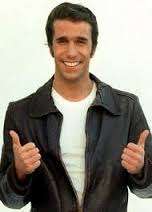
Bernie Sanders and The Fonz

I would vote for this guy!


As I hope you are aware, this is a picture of Larry David, who has played Bernie Sanders on Saturday Night Live.  (It’s REALLY funny.  See here.)

I would never vote for Bernie Sanders for a whole bunch of reasons.  (I would never vote for lots of other past and current candidates this election season.)  It should not be ignored, however, that there is a Jewish candidate who is not doing half bad as a major party candidate.

How Jewish is Bernie Sanders?  A lot has been written and speculated.  He spent time on a Kibbutz.  He sounds really Jewish.  The latest news is that he will not attend the AIPAC Policy Conference.

Charles Krauthammer wrote an op-ed in the Washington Post last week about the Holocaust and Jewish identity.  In a recent Democratic debate, Anderson Copper asked Bernie Sanders about his Jewishness.  Sanders responded, “I am very proud to be Jewish.”  He then explained that the Holocaust had wiped out his father’s family and that he remembered as a child seeing neighbors with concentration camp numbers tattooed on their arms.  Being Jewish, he declared, “is an essential part of who I am as a human being.”

Krauthammer went on to analyze the three ways American Jews explain the role Judaism plays in their lives.

1.  Practice: Judaism as embedded in their life through religious practice or the transmission of Jewish culture by way of teaching or scholarship.

2.  Tikkun: Seeing Judaism as an expression of the prophetic ideal of social justice.

3.  The Holocaust.  It has become increasingly common for American Jews to locate their identity in the Holocaust.

Leaving presidential politics aside for a moment (I know it’s hard!), it is unfortunate when Jewish identity is shaped exclusively – or even primarily – by the Holocaust.  Obviously, the Holocaust has shaped Jewish life today, but it need not be the defining characteristic.

The Holocaust is evil, but, as much as we must remember it, we should not be dwelling on that evil.

Like The Fonz.


There was another article in the Washington Post recently.  It was about Henry Winkler (who played The Fonz on the hit show Happy Days) and how he still maintains and cares for the plant that his "aunt" brought with her when she escaped Germany in a coffin.  It is a fascinating and moving story.  

When Winkler left home, he took a few items with him – one of them was the plant.  He said, “I grew up with it, I heard the story, and I thought maybe it’s my responsibility to make sure it lives.”  When asked what the plant means to him, he responded, “Life, tenacity and will.”

These two stories stand out for me as contrasting.  They are both rooted in the Holocaust, in the worst evil the Jewish people has ever faced.  There are those who let this evil color everything else.  I get it, but there needs to be more.  We need to move beyond the past.  It informs who we are, but we can take a difficult past, cultivate it, and transform it into a glorious future.

As Jews, we live with our history constantly.  Will we get lost in the darkness of our struggles or will we rise to the occasion and recognize that Judaism gives us the opportunity – the privilege – to live meaningful, purposeful, lives while creating a brighter society?

I vote for the latter.

Fonz, what do you say?  Correctamundo!

Friday, March 11, 2016

Tefillin on Death Row & Happy Second Adar

Did you see this picture?


This is a picture of Rabbi Dovid Goldstein, director of Chabad-Lubavitch of West Houston, Texas, and Jedidiah Murphy, a death-row inmate in a West Livingston, Texas prison.  (Guess which one is which. J

The story was picked up in the Jewish press a few weeks ago, and there is longer story about this subject on Chabad’s websiteRabbi Goldstein enabled Murphy, convicted for killing a 79-year-old woman, to lay tefillin for the first time.  It was not easy to arrange as state law prevents death row inmates from having direct contact with their visitors.  Goldstein provided the tefillin and a kippah for Murphy and instructed him through the glass.  Rabbi and prisoner celebrated the “Bar Mitzvah” with chips and soft drinks from the nearby vending machine.

(This was not Goldstein’s first time putting tefillin on a death-row inmate.  In 2013, he helped Douglas Feldman put on tefillin one week before being executed by lethal injection.  That time, he was allowed direct contact with the prisoner since the tefillin were considered part of his last rites.)

What can we take away from a story like this?

There are Jewish criminals…Chabad is dedicated to every single Jew…It’s never too late to perform a mitzvah…

I find myself thinking about how we approach second chances.  Murphy never had a Bar Mitzvah or a chance to act in a Jewish way.  It took a death-row encounter with a truly dedicated rabbi to create this mitzvah moment.  Often, we seek out second chances in moments of extremis.  We repent in time for Yom Kippur or we try to spend more time with someone after not spending time with them earlier.  As the saying goes, “Better late than never…”

Why can’t there be more opportunities to seize the moment?  How about more positively-induced second chances?  We could each benefit from proactively wanting to do all these good things because they are too good to miss out on, and we want to experience them again.

Do you remember this commercial?


A father and his daughter are sitting watching a sunset, and, as the sun sets, the dad says, “Going...going...going...gone!”  And then the girl says, “Do it again, Daddy!”  It is really cute.

There are so many things we should try to experience again because they are just so special and awesome that, heck, why not?  We don’t need to wait until the last minute – or when it is too late – to try and spend more time with our family or enjoy the beautiful weather or read that book or try that new experience.

Today, we are reminded of just such an opportunity.  It is Rosh Chodesh Adar Sheini (the second).  Adar is a happy month, and…guess what?  We have a second opportunity to be happy!  We had one happy month, and now we have another one.  We have a chance to grab the opportunity for a second consecutive month of joy.  Had enough?  No way!  Enjoy while we can.

We may not be able to make the sun set again, and we, most certainly, don’t want to need to be on death row to push us to perform a mitzvah.  For now, let us savor a second month of simcha and think about what other positive experiences - for religious and personal growth or spending time with family or just doing wonderful things – we can grab. 

Happy Adar once again!  Let’s enjoy it all while and when we can!