Friday, February 23, 2024

Wise Hearts


Rabbi Shlomo Riskin relates an encounter with a congregant who was not observant. The man would reassure the rabbi of his commitment to Judaism by saying, “Rabbi, I don’t keep the rules, but I have a Jewish heart.” Rabbi Riskin replied, “I am worried about the strain on your heart. Perhaps, let other parts of your body take on some Jewish responsibility. Use your mouth to pray and keep kosher. Put tefillin on your arm and head. Use your legs to walk to Shul…”

A Jewish heart. A Yiddishe kop – A Jewish head or mind. A pintele Yid – the Jewish soul. The parsha introduces us to another kind of Jewish organ: the wise heart.

"V'ata tedabeir el kol chachmei leiv...v'asu et bigdei Aharon - And you (Moses) shall speak to all of the wise hearted people...and they shall make the garments for Aaron..." (Shemot 28:3)

Hashem specifically instructed Moses to command the wise of heart to make these special garments for Aharon and his sons. We are accustomed to associating wisdom with the brain. Why does the Torah emphasize a wise heart?

Rabbi Riskin is on to something. We need to find a way to channel our intelligence into our emotions and infuse emotion into our intelligence.

1)  Smarts are not enough

Rabbi Leib Chasman, a Yeshiva head in prewar Europe, explained that our understanding of wisdom represents a fundamental flaw in human thinking. From the Torah's perspective, a wise person is not merely a Harvard professor who is able to intelligently discuss esoteric topics and difficult academic subjects. If their actions don't reflect their sophisticated intellectual knowledge, the facts and theorems stored in their head are essentially meaningless.

Rabbi Norman Lamm put it this way: Wisdom without conscience yields to misuse of knowledge. The atom bomb was an ingenious invention, but it led to horrific destruction. Man was able to decipher the “nature of the atom but neglected the nature of the sons of Adam.”

The Torah recognizes that the primary criterion for determining wisdom lies in the ability to connect one's mind, and the information stored therein, with the heart, which guides and determines actions. It is for this reason that Hashem stressed the importance of selecting the truly wise - the wise of heart.

2)  We must think outside the box


We sometimes get stuck in our thinking. For example, we expect things to look a certain way. Think about how we picture a tzaddik, Jewish sage. With a beard? Holding a book? Davening? A wise heart looks deeper.


Alan Watts, a popular writer on Eastern religion, offered a keen insight: “The most spiritual people are the most human. They are natural and easy in manner; they give themselves no airs: they interest themselves in ordinary everyday matters, and are not forever talking and thinking about religion. For them, there is no difference between spirituality and usual life…” (“The Supreme Identity”, p. 128).


The Jewish tradition references the idea of 36 nistarim, hidden righteous individuals who allow the word to exist. Rabbi Marc Angel explains they are hidden because the truly righteous are too modest to imagine that they are among this group of tzaddikim. It might be the person sitting next to you…

3) Wisdom is only genuine when accompanied by caring

Teddy Roosevelt said, “Nobody cares how much you know until they know how much you care.”

Knowledge is something for which we have passion and wish to use to share with others or benefit them.

We value information, the mind, and wisdom. At the same time, as the Talmud teaches, “rachmana liba ba’ee – God wants the heart.” Our mission is to fuse both to create wise hearts.

These days, we are bombarded with information as we follow events in Israel. At the same time, our hearts are broken by the stories of heroism, widows and orphans left behind, and tremendous need. I don’t worry as much about our minds. We absorb plenty of information, news articles, and opinion pieces – probably more than enough. I think we need to lead with the heart.

In connection with this week’s parsha and the project of the bigdei kehuna, priestly garments, I came across an expression which resonates deeply: “Wear your heart on your sleeve and your people on your heart.” Wise hearts are needed more than ever as we daven, care, donate and show our love for Israel and the Jewish people.

Thursday, February 15, 2024

The Power of Shul


What's the most powerful memory you have of your hometown shul?

While the synagogue experience centers around davening and, of course, Kiddush, shuls have a way of powerfully instilling a sense of pride, history, and tradition. 


Like the Ballarat Synagogue in Australia, an hour’s drive from Melbourne.


The town rose to prominence during the mid-19th century after gold was found there in 1851, igniting a gold rush. The city attracted Jews from England and elsewhere in Europe who were seeking their fortunes or escaping antisemitism. In 1853, a minyan was established on the Ballarat goldfields for the High Holidays, and the synagogue was consecrated in 1861. The community has dwindled, but the shul's history is chock full of memories that formed the Jewish consciousness of all who passed through. And, after 162 years, the Ballarat Synagogue continues to host a monthly Orthodox Shabbat service and a Shabbaton for locals, natives, and the curious alike.


I have many memories of the Young Israel of New Haven, CT (pictured above), my hometown Shul. 


I led Anim Zemirot and Adon Olam on Shabbat morning, served as "Junior Gabbai," helped set up and clean up Kiddush, and even scraped tiles to help replace the basement floor. Some might say it was perfect training for my chosen vocation!


I learned from rabbis, Holocaust survivors, Siberian exiles, and third-generation Americans. They formed an interesting cast of characters I still remember fondly today. Like Harvey Schwartz, of blessed memory. Here are a few lines from his obituary written by his family:


"A Veteran of the US Navy, and a long-term employee of the US Postal Service until his retirement. He enjoyed travel...He was an avid professional sports fan with a special fondness for horse racing…However much he traveled and sought entertainment through sports, the priorities in his life were always fellowship with the members of his synagogue, and the fulfillment in his daily practice of Orthodox Judaism."


Harvey was a “Shul Jew." He did not have a Jewish education nor was he learned in Jewish texts. Instead, Harvey's Judaism was an extension of the Shul. He could always be counted on to be at minyan and, for as long as I can remember, it was Harvey who led Pesukei D’Zimra on Shabbat and Yom Tov mornings. His Judaism seemed to be wrapped up in shul.


We build Shuls, but Shuls also build us


"V’asu li mikdash v’shachanti b’tocham - They will make for Me a sanctuary, and I will dwell within you." (Shemot 25:8)


The commentators note the shift in pronouns from third person to second person. The verse should read "They will make for Me a Sanctuary, and I will dwell within it." Why does it say instead "I will dwell within you?"


The classic answer is that building the mishkan or synagogue is a way for us to bring God's presence into our worlds and into our hearts. As Rabbi Elazar Azikri beautifully put it, "Bi'levavi mishkan evneh - In my heart, I will build a sanctuary." The mishkan is a way for us to bring heaven down to earth. Similarly, a shul and all its religious activities make us more Godly. If we build a shul, God will dwell within us.


I'd like to suggest that the verse as written makes a lot of sense. If they build a synagogue and create a meaningful, inspiring, uplifting, traditional, kind, and caring environment, that purposeful, delightful Judaism will be felt within you. If we build a shul and and experience its Jewish dynamism to the fullest, that's how God will dwell within us. A powerful shul experience will help us feel God more in our lives.


Shul shapes us as Jews. It's more than the davening or the Kiddush. It's more than the Torah reading or fulfillment of rituals or the social connections. These are all great. At the same time, a shul radiating Torah, tradition, kindness, prayer, and connection will provide us with memories that will last a lifetime and make us better people and better Jews.


So come to shul! Experience shul. Help build that sanctuary that will remain with you and enhance your life, the lives of your children, and the whole Jewish people. 

Friday, February 9, 2024

To Be a Jewish Doctor


A story is told of the mother of the first Jewish President who receives a call inviting her to fly on Air Force One. She hangs up the phone, and her friend asks, “Who was that?” She replies, “You know my son the doctor? That was his brother.”

This joke is just one variation of the humor created around the reality of a deep Jewish connection with medicine and a long history of Jewish doctors. (I’m sure many of you immediately thought of Maimonides.)

Sherwin Nuland, an American surgeon and author, recounts in his book, Maimonides:

“Imprisoned in a tower in Madrid, disabled by syphilis and further weakened by an abscess in his scalp, the French King Francis I asked of his captor, the Holy Roman Emperor Charles V, that he send his finest Jewish physician to attempt a cure. At some point soon after the doctor arrived, Francis, in an attempt at light conversation, asked him if he was not yet tired of waiting for the Messiah to come. To his chagrin, he was told that his healer was not actually Jewish but a converso who had long been a baptized Christian. Irate, Francis dismissed him and arranged to be treated by a genuine Jew, brought all the way from Constantinople.” (p.3)

The story may be apocryphal, but it certainly fits with our long tradition of Jews being doctors. Nuland notes that during the Arabic period, approximately half of the Jewish doctors were also rabbis. He also found that, in the first half of the fourteenth century, only 5% of the population of Marseilles was Jewish, but they accounted for 43% of the city’s physicians. (p. 12, 14)

The trend continued into the modern era. In America, Jewish medical school candidates reportedly made up 60 percent of the applicant pool in 1934. Even as the numbers have been dropping precipitously (only 9% in 1988), Jews are still disproportionately represented in medicine. While Jews are 2% of the population, they make up over 14% of doctors. (For some comparisons, Protestants are 55% of the population and make up 49% of doctors. Hindus are 0.2% of the population, yet 5.3% of doctors.)  

What’s so Jewish about being a doctor?

Two words. “V’rapo yerapei – One must definitely heal.” (Shemot 21:19)

The Talmud (Berachot 60b) comments that this verse gives permission for the doctor to heal. Why is permission needed? Rashi (Bava Kamma 85a) writes that one might have thought that if God caused a person to be ill, we should not attempt to undermine the divine decree. The verse therefore states that one is permitted to heal an ill patient. Other Sages (unsurprisingly many of those rabbis who were also doctors) offer a different view. There is a mitzvah to heal.

There is a religious tension in medicine. On the one hand God is in charge. If a person is sick, then maybe that’s the way it should be. On the other hand, we value life and do whatever we can to preserve it.

A decade ago, the Yeshiva University Museum hosted an exhibit on Jews and modern episode. A review noted how Jewish doctors had differing religious reactions to the role of medicine. Waldermar Haffkine (1860-1930), inventor of the world’s first vaccine for cholera and the Bubonic plague, fought to maintain a strong Orthodox identity in the face of a rapidly changing world. On display was a reflection of his noting “the faith which binds together the Jews has not been harmed by the advance of research, but, on the contrary, has been vindicated in its profoundest tenets.” A very different view was held by Joseph Goldberger (1874-1929), a five-time Nobel Prize-nominee. The exhibit notes that while raised Orthodox, Goldberger found it impossible for his scientific endeavors and Jewish tradition to coexist. Goldberger even went on to marry Mary Farrar, the grandniece of Jefferson Davis.

Some doctors bring a strong Jewish perspective to their practice of medicine. Think of the late Rabbi Dr. Abraham Twerski, noted psychiatrist and scion of a Chasidic dynasty, who merged the two worlds of science and faith. At the same time, it seems that, for many Jewish doctors, their Judaism isn’t part of their profession. A study on Jewish doctors and the role of their faith found that Jewish physicians were more likely than other religiously affiliated physicians to rarely or never attend religious services. They were also less likely to believe in God. Compared to Protestants and Catholic doctors, the Jewish doctors did not see religion influencing health very much nor do they discuss their faith and spirituality with their patients.

Jews and medicine are a typical expression of Judaism. It may be a spiritual calling, a necessary activity, a cultural expression of the past, or part of our history. (I heard the comedian Jackie Mason explain that Jews becoming doctors was a means of self-preservation and protection. Nobody would dare insult or harm the person who might save your life.)

Rabbi Joseph Soloveitchik, in Out of the Whirlwind (pp. 102-104), adds another dimension to “v’rapo yerapei.” It is not specific to medicine. It is the mandate to heal. Illness is one form of “evil” that people face. “V’rapo yerapei” teaches us not to make peace with evil. We cannot presume that we are helpless when facing illness – or any form of evil. Rather, we “should actively interfere with evil. Man is summoned by God to combat evil, to fight evil, and to try to eliminate it as much as possible.”

For the Rav, v’rapo yerapei” is not just speaking to medical professionals. It is a call to humanity not to sit back and do nothing when confronted by evil or illness or loneliness or any other need. We’re all called to be doctors!

I find that, often, doctors’ sons become rabbis, and rabbis’ sons become doctors. (I am sure there’s a whole psychology behind it.) Earlier this week, a doctor who’s the son of a rabbi shared a great point with this rabbi who’s the son of a doctor. The etymology of “doctor” is from the Latin word for teacher. Well, rabbis are also teachers. Ipso facto, then I’m a doctor!

There may be so many Jewish doctors because the healing imperative is essential to our lives. We can each share health, wealth, knowledge, and kindness. There’s a reason God says, “Ani Hashem rof’echa – I am the Lord, your healer.” (Shemot 15:26) God is the ultimate Doctor. God is the source of all, Who shares with us. In our efforts of Imitatio Dei, to follow God’s example, we all need to be doctors, to share and benefit others in every way we can.

Good Shabbos! Good Shabbos! Am Yisrael Chai!

Friday, February 2, 2024

Groundhog Day Judaism


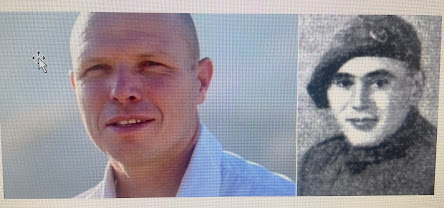
This is Yossi Hershkowitz.

They’re both Yossi Hershkowitz.


The one on the right was born in 1924 in Romania and immigrated to Israel in 1944. He was a member of the Haganah and was killed in action fighting in July 1948 in the War of Independence, leaving behind a wife.


The Yossi Hershkowitz on the left was killed in action in Gaza in November, leaving behind a wife and five children. He served as the beloved principal of ORT Pelech High School for boys in Jerusalem. “Today in Israel there is no right wing, no left wing, no Haredim. Just Jews,” he said in a video he sent his students, wearing his green fatigues. He offered words from Torah, and quoted the late chief rabbi of Great Britain, Jonathan Sacks, about holding onto one’s faith during times of crisis and the Jewish people’s power to bring light to the world.


The more things change, the more they stay the same.


These last months, each day brings similar headlines.

“Dozens of terrorists killed in clashes with IDF”

“Rocket alerts sound in Gaza border communities”

“IDF says fighter jets struck Hezbollah sites across southern Lebanon”

“Houthis target ships in Red Sea”


It can feel like the movie “Groundhog Day,” in which the main character experiences the same day over and over again. Like the movie, maybe our takeaway is to appreciate the ability to improve while moving forward and not get stuck without some elements of growth each day.


These days, we need a reminder more than ever of “the miracles we experience each day and the wonders and goodness present at all times – evening, morning, and afternoon” (Modim blessing of Amida prayer).


The truth is, like in the movie, no two days are ever the same. Each situation is different and experienced differently by those involved. There may be two heroes named Yossi Hershkowitz, but each is unique, their wars were unique, and the Jewish situation has changed over the 75 years of Israel’s existence between their sacrifices.


Judaism can sometimes feel like “Groundhog Day.” We wake up, daven three times a day, and celebrate Shabbat each week and the same holidays each year. Didn’t we read Parshat Yitro last year?


Judaism is a great big ball of similar, familiar, interconnected experiences that transcend time. They may repeat, but our mission is to find ways to make them relevant, new, and exciting. Each day we read in the Shema (Devarim 6:6), “Take to heart these instructions with which I charge you this day.” The Midrash teaches that “this day” means each day, Judaism should feel fresh and new.


And Judaism is not as powerful without the shared experience of everything that came before and will come after.


Rabbi Pini Dunner uses a terrific text that shows the entire Jewish experience as having been produced already. The Talmud (Menachot 29b) tells of Moshe being transported to the Beit Midrash of Rabbi Akiva.


“When Moses ascended on High, he found the Holy One sitting and tying crowns on the letters of the Torah. Moses said before God: Master of the Universe, who is preventing You from giving the Torah without these additions? God said to him: There is a man who is destined to be born after several generations, and Akiva ben Yosef is his name; he is destined to derive from each and every thorn of these crowns mounds upon mounds of halakhot. It is for his sake that the crowns must be added to the letters of the Torah.

Moses said before God: Master of the Universe, show him to me…Moses went and sat at the end of the eighth row in Rabbi Akiva’s study hall and did not understand what they were saying. Moses’ was distressed as he thought his Torah knowledge was deficient. When Rabbi Akiva arrived at the discussion of one matter, his students said to him: My teacher, from where do you derive this? Rabbi Akiva said to them: It is a halakha transmitted to Moses from Sinai. When Moses heard this, his mind was put at ease, as this too was part of the Torah that he was to receive.”

Like Moshe, we may be frustrated as to our role in the story. Maybe the story doesn’t seem to be going anywhere. We need to seek the connection. We need to find meaning and purpose and freshness and relevance in the repeating rituals, the recurring headlines, and in the death of the two Yossi Hershkowitzes. We are all connected across the Jewish world and Jewish history.


Let’s find a way to distinguish each day and contribute our mitzvah, our action, our small element to the glorious production of Judaism.

Friday, January 26, 2024

Quiet Down!


 All that is expected of us is to be quiet.

Hashem yilacheim lachem v’atem tacharishun – God will fight for you while you should be quiet.” (Shemot 14:14)


With the Egyptians bearing down on them, the Jews, understandably, panic and question leaving Egypt. Moshe reassures them by promising salvation. “God will take care of it. All you need to do is be quiet.”


Silence is golden. Silence can be uncomfortable. We like to talk.


Like in Shul.


There is an old joke about an atheist who goes to shul every week and sits next to his friend Goldberg. One day, someone asks the atheist why he keeps coming to services if he doesn’t believe in God. He replies, “Goldberg goes to shul to talk to God. I go to shul to talk to Goldberg.”


Over the years, some groups have designated this Shabbat as “Shabbat Tacharishun,” a Shabbat to focus on decorum. As one rabbi explained, “Hashem will fight for you against the schemes of the evil inclination, but that is provided you fulfill the condition in the verse, ‘and you shall remain silent.’ If you restrain yourselves from speaking about worldly matters in shul, then you will merit God’s assistance.”


Let’s just say it’s not a very popular initiative…


Talking in shul has always been an issue. In the 17th century, Rabbi Yom Tov Lipmann Heller composed the following prayer:

May God Who blessed Avraham, Yitzchak and Yaakov, Moshe and Aaron, David and Shlomo bless those who guard their mouth and tongue from speaking during prayers. The Holy One Blessed be He shall guard them from every trouble and distress and from every plague and illness, and they shall be subject to all the blessings written in the Torah of Moshe and all the Prophets and Scriptures. May they merit healthy children educated to become Torah scholars, marry them off and educate them to do good deeds, and serve Hashem truthfully. Amen.

People like to talk. People, thankfully, feel comfortable in Shul. Put them together, and talking in Shul doesn’t feel so wrong. I get it. While I discourage talking and hope that people who feel the need to talk – and loudly at that – take it outside, we should try to better appreciate the power of silence. We come to shul to daven, to learn, to see people, and, last but not least, to enjoy Kiddush. Our silence can enhance our davening and the experience of those around us. Religious law aside, keeping quiet in shul is an opportunity to strengthen ourselves with the positive power of silence.

V’atem tacharishun – What are some benefits of silence?

First, silence demonstrates faith. While we believe in the necessity of human effort, there comes a point when we must also nurture our appreciation that God plays a guiding role in our lives. One of the most powerful demonstrations of humility and faith is silence. We don’t have all the answers. What we see in front of us – like what the Jews saw in front of them at the sea, isn’t the whole picture. Stop, listen, contemplate, silence.

Second, silence shows strength. As columnist Peggy Noonan noted, the term “strong silent type” emerges from the fact that silence can reflect self-confidence without needing to fill the pauses with words. It indicates a person’s ability to control or even transcend a situation. The loudest person in a room is often the most insecure. Silence can also add a layer of mystery, intrigue, and respect. People wonder what the silent person is thinking and, therefore, respect their silence. The interplay between silence and respect is on display every time we observe a “moment of silence”.

Third, silence expresses empathy. One of the first skills mental health professionals learn is “active listening.” It entails overcoming the urge to speak first, to interject, or question someone in the middle of their talking. Active listening employs silence to provide space that allows the other person to express themselves while also feeling as if they have been heard. Empathic silence and active listening are essential at a shiva house. It can be very uncomfortable to sit there silently, yet that is what Jewish law proscribes and the mourner needs.

“Rabbi Shimon would say: All my life I have been raised among the wise, and I have found nothing better for a person than silence.” (Avot 1:17)

Talking is terrific. We talk to God. We talk to friends. We share our views. We make friends. It is easy to talk.

Silence is sublime. We connect to God and people through silence. We demonstrate our strength, wisdom, and compassion through silence.

We live in a loud, noisy world in which everyone seems to have something to say. We would all benefit from a little more silence, a little more patience, a little more kindness, a little more empathy, and a lot more humility.

Actions speak more loudly than words. Silence may speak loudest of all.

Friday, January 19, 2024

Money, Money, Money, Money

Here are some notable songs featuring money:

For the Love of Money” by the O’Jays (1973)
Money, Money, Money” by Abba (1976)
Money” by Pink Floyd (1973)
Money is for Nothing” by Dire Straits (1985)
For something Jewish, there’s “Gelt” by Lipa Schmeltzer.

On the one hand, as sung in the musical Cabaret, “Money makes the world go round.” On the other hand, “Money is the root of all evil.” (Timothy, I 6:10) People have a complicated relationship with wealth. For Jews, who are stereotypically associated with money, our relationship with wealth begins at the very beginning of our history as a nation.


The setting: Pharaoh offers to free the Jews, but the children and cattle - the wealth - must be left behind. Moshe refuses. Pharaoh angrily dismisses Moshe, threatening him with death should they meet again. God announces one final plague that will, finally and definitively, free the Jews. And?

“Please, speak into the ears of the people, and let them borrow, each man from his friend and each woman from her friend, silver vessels and golden vessels." (Shemot 11:1-2)

One more plague to go and the Jews go free. But, first, the Jews need to borrow gold and silver.

The same interruption is found as the Jews leave Egypt. Pharaoh says, “Go! Get out! Take everyone and everything!” The Egyptians, fearing that they’ll all die, try to hurry the Jews out, not even allowing them time for the bread to rise. Not so fast…

And the children of Israel did according to Moses' order, and they borrowed from the Egyptians silver objects, golden objects, and garments. The Lord gave the people favor in the eyes of the Egyptians, and they lent them, and they emptied out Egypt.” (12:35-36)

What is so important about the money?

1)  A promise is a promise.

God promised Avraham that his descendants would leave Egypt “bi’rechush gadol, with great wealth.” The gold and silver the Jews received from the Egyptians served as payment or reparations for the slavery. The Midrash reinforces the Jewish claim to this treasure.

During the time of Alexander the Great, the Egyptians took the Jewish People to court and sued them for the gold and silver that they "borrowed" from them during the Exodus and never returned. An outsider named Gaviah ben Pasisa volunteered to serve as the defense attorney for the Jewish People. He asked the Greek monarch, "From where do you bring proof that we unlawfully took the money?" He responded, "From the Torah."  

Gaviah countered, "Then I will bring proof from the Torah, where it states that the Jewish people dwelled in Egypt for 430 years. Please give us the wages of 600,000 workers for that time period, and we shall return the gold which we took." The Egyptians requested a three-day recess, and did not return to the court.

The gold and silver vessels were an attempt to compensate the Jews for slavery. It was about more than the money. The rechush gadol was an attempt to shed the slave mentality. Avraham knew it would not be enough for the Jews simply to leave. Years of oppression were bound to leave their mark. After all, the Egyptians took so much from each individual Jew: their peace-of-mind, their optimism, their children’s lives. Avraham was not satisfied with merely an Exodus. Just as the Egyptians took from Bnei Yisrael, Bnei Yisrael needed to take in order for that chapter to be closed. The despoiling of Egypt served as what can be called the “Minimal Effective Response” so that the nation’s journey could begin.

2)  One can do a lot of good with money.

As Tevye said: “There’s no shame to be poor, but would it be so terrible to have a small fortune?” Despoiling Egypt is an opportunity to focus on the possibilities and responsibilities of wealth.

In some segments of Christianity, there is what is called a prosperity gospel. This teaches that financial blessing is the will of God and that faith, positive speech, and donations to specific ministries will increase one's material wealth. It is quite controversial. Judaism rejects such an approach, but Judaism recognizes the good that can and must be done with one’s resources.

It’s impossible to strip money matters from spiritual life, because the two are so intertwined. Let’s face it, mitzvot cost money. The price of a Jewish education continues to rise. We believe in “hiddur mitzvah, beautifying the mitzvah,” which can add to the cost. There is a mitzvah of tzedakah, charity, and even the poor are required to give something.

As Bnei Yisrael leave Egypt, an essential lesson is taught: Your new life is going to cost you. It may be, at times, expensive. It is important to appreciate the need for resources and to use them in the service of God.

3)  There are things more important than money.

The Torah’s focus on wealth in the formative narrative of the Jewish people teaches both the value and importance of money alongside the truth that our worth is not defined by money. As Rabbi Joseph Lookstein, of blessed memory, used to say: “You should never put money ahead of everything, but you have to put money behind everything.”

A story from Israel.

Zvika Gringlik hit a car. He exchanged details with the owner of the car and told her, “I'm to blame, I wasn't okay, and we'll fix what you need in the car.” They arranged to meet at the garage on Wednesday. On Wednesday, the woman arrived at the garage, but Zvika Gringlik did not come. She tried calling him, and he did not answer. On Thursday, the woman sent him a message: “I'm disappointed. We arranged for Wednesday, and you didn't come.”

Zvika saw the message and immediately replied: “I'm very sorry. On Tuesday my son Shaul was killed in Gaza, so I couldn't come.”


The woman immediately apologized. She herself had been at the funeral, but she did not make the connection that Zvika was Shaul's father. That same day, she arrived at the shiva home and comforted the family. During the shiva, Zvika told her: “When the shiva is over, I will transfer the amount of the repair to you.” She told him: “Don’t worry about it, I don't want the money.”

At the first opportunity, Zvika transferred NIS 2,000 to the woman via Bit (the Israeli Venmo). She sent him a message that made him weep: “There is no need. The owner of the garage heard that the person who hit the car was the father of a soldier who fell in Gaza, so he fixed the car without taking money.”

If we truly understand wealth, we know there are things far more valuable than money.

As the Jews left Egypt, they needed to learn the true value of money. Our wealth and financial resources present us with opportunities, choices, and challenges. They also represent a finite, quantifiable baseline of who we are and what we can accomplish. We need to strive to achieve lives of value through actions that money just can’t buy.

Friday, January 12, 2024

How Are You?


It’s a very common question.

We see someone, we ask, “How are you?” It’s innocent, simple, not overly intrusive. It can be answered pretty easily.

I remember a rabbi in my Yeshiva in Israel relished teaching students a lesson with this question. He would ask a student, “How are you?” The good yeshiva bachur would answer, “Baruch Hashem, thank God.” The rabbi would pounce and say, “I didn’t ask about the state of your belief. I asked how you are.”

In a way, “How are you?” simply fills space. One journalist described them as “the three most useless words in the world of communication. The person asking doesn’t really want to know, and the person responding doesn’t tell the truth.” We can do better if we want to make small talk. We can open with questions like “What’s your current state of mind?” or “What are you looking forward to this week?”

These days “How are you?” is a loaded question. Many people are not fine. Is it OK to be fine?

Sivan Rahav Meir mentioned a fascinating and deep approach to this question in the name of Rabbi Yoram Eliyahu, whose son Yedidya Eliyahu, z”l, fell in Gaza. Whoever asks him “How are you?” receives the following answer: “Learning. We are learning.”

Rahav Meir writes, “In my view, this answer is most profound. It’s about being broken and shaken, yet accepting the challenge of life as it goes on. It’s about learning how to digest and cope with what happened and the obligation to see what all of this can teach us.”

How are you? We might answer “fine” or “Baruch Hashem,” but the question allows us to evaluate where we stand right now and how this stage is part of a continuum. How am I? I can say fine because that is how I am trying to feel or how I will feel once I make it through the pain or the challenging times.

Have you heard of PTG? It stands for post-traumatic growth. Traumatic experiences can lead to stress. They can also lead to growth.

Developed in the mid-1990s by psychologists Richard Tedeschi, Ph.D., and Lawrence Calhoun Ph.D., post-traumatic growth theory is defined as, “the experience of positive change that occurs as a result of the struggle with highly challenging life crises.”

Everyone will deal with struggles and traumatic experiences in their own way. At the same time, there is an opportunity to grow from the pain. As the saying goes, what doesn’t kill you makes you stronger.

One example of PTG that has been analyzed is Kay Wilson. Kay struggled to make her way through a Jerusalem forest after being repeatedly stabbed by a Palestinian terrorist. She distracted herself from her agony by playing the song "Somewhere Over the Rainbow" in her mind. Wilson, then 46, had been working as a tour guide when, on Dec. 18, 2010, she and a friend were ambushed by terrorists. Wilson witnessed her friend's murder and was herself viciously stabbed with a machete, ultimately playing dead as her attacker plunged his knife into her chest one final time. She eventually recovered from her severe physical wounds and is healing from her psychological trauma. She now speaks to global audiences about her survival, hoping to "dispel hatred, whether toward Arabs or Jews."

As Lorna Collier notes, “After the attack, Wilson had flashbacks and deep survivor's guilt. But like many people who have survived trauma, she has found positive change as well—a new appreciation for life, a newfound sense of personal strength and a new focus on helping others.”

I think of this automatic “How are you? Fine” dynamic a lot with regards to the situation in Israel and particularly the plight of the hostages. “How are you?” has got to be the most loaded question to ask anyone in Israel today. And yet…Many will respond “Fine” before stopping themselves to add an understandable qualifier.

The same is true with the horrific and painful hostage reality. What can we do? We can daven and maintain awareness. This morning, I attended the rally in Manhattan marking 100 days of captivity. I joined the Ramaz Minyan, which ended in a circle with songs of hope, strength, and unity. There was a nice showing that filled East 47th Street between Second and First Avenues – including a nice number of Atlantic Beach faces. Each of us there amplified the demand to release the hostages and bring them home now. Did we accomplish anything? How was it? Fine. Those who attended, those who daven daily, those who wear the hostage “dog tags” or display the number of days in captivity are striving to do something that can make a difference. We want to move beyond this nightmare. At the same time, we want to do something – anything – to be connected with the families and take any action in which we can share their pain.

I think there is a similar motivation behind all the duffel bags sent or meals cooked or any of the actions – large or small – we are all taking on behalf of the soldiers and citizens of Israel. We want to transcend the feelings of pain and helplessness. “How are we?” We will be fine.

I will likely keep using “How are you?” as a default opener. (Yes, I will try to be more interesting or profound, but it’s just so easy.) I will try, however, to use the question – as well as my answer – as a chance to grow. Whatever the situation is right now, it can change. I can make it change by learning something new, by trying something different, by doing something – no matter how small – to make the situation better.

Last week, as the Egyptian slavery began, we read the famous verse (Shemot 1:12): “The more they afflicted them, the more they multiplied and spread.” May the difficulties we face today provide opportunities for explosive growth, improvement, and enlightenment, and may we – like our ancestors in Egypt - merit a sense of redemption.