Friday, September 16, 2022

Let's Not Forget What We Did Right


We are entering a season of confession. Starting with Selichot, we will confess dozens of times before Yom Kippur ends. Parshat Ki Tavo contains a unique type of confession.

Asiti k’chol asher tzivitani - I have acted according to everything that You commanded me.” (Devarim 26:15)

This verse is part of the confession which is recited when one turns over the tithes to their rightful recipients. Why are we commanded to confess to doing the right thing? Confession is usually associated with making amends for mistakes!

Often, we feel improving means to admit mistakes and talk about what went wrong. The only way to move forward and grow is by admitting and overcoming the mistakes of the past. The lesson of this different confession is that we need to confess what goes right as well. Of course, we must own up to our mistakes and shortcomings. We also need to admit that some things, indeed, are going well. During this season of reflection, we tend to be overly focused on the mistakes, but we need to also remember the good things. This can encourage and inspire us to be even better.

It makes sense that we associate confession with the negative. Often, that is our default setting. Judaism asks us to transcend that default setting. Add a little joy to the reflection and repentance. Rabbi Jonathan Sacks quotes Soren Kierkegaard, who wrote, “It takes moral courage to grieve; it takes religious courage to rejoice.” I know there is plenty of guilt and contrition this time of year – and that’s not all bad. At the same time, let’s not forget what we did right and feel pride and joy over what we accomplished.

During the High Holidays, the verse that stands out for me is “Gilu bi’re’adah – rejoice while trembling.” (Psalm 2) Judaism is a religion of joy. We must declare that we can overcome obstacles and transcend limitations. It need not be easy, but it is always possible.

Let’s confess. Let’s confess to what needs fixing. Let’s also confess to what works while striving for what is possible.

Friday, September 9, 2022

Carry On Wayward Son


Whenever I hear the song by Kansas, I think of the ben sorer u’moreh, the rebellious child. While the song is not religious and the lyrics have nothing to do with the Torah’s account, I just feel that “wayward” is a better way to describe the child than rebellious, and I like the music.

The text (Devarim 21:18-21) does not provide very many details. There is a child not listening to their parents. The parents discipline the child to no avail. They tell the elders that the child is disobedient as well as a glutton and drunkard, and the child is executed by stoning as a cautionary tale. If this sounds strange, the Talmud (Sanhedrin 71a) delves more deeply into detailed conditions so unlikely that there never was such a case. Why, then, does the Torah teach it?

D’rosh v’kabel s’char – We are to study this issue and be rewarded with the lessons we learn from this exploration.

What lesson? Essentially, the ben sorer u’moreh scenario highlights the importance of moderation, discipline, and communication. These are key ingredients in parenting as well as any relationship.

The Talmud (Sanhedrin 88a) teaches that if the parents forgive their rebellious child, then the child is forgiven, and no punishment is meted out. Rabbi Shmuel Borenstein, in his Shem Mi’Shmuel, asks a very fundamental question. We are ready to execute the rebellious child for his sins even if – let’s be honest – they’re not so terrible. We are so worried about what the child will ultimately become that we take drastic, preventative action. And you want to tell me that if the parents are willing to excuse and forgive their child that he is now off the hook?! That’s ridiculous! What role should parents’ forgiveness play in such a case? If the situation is so dire that we’re ready to execute the child, it would seem like we’re well past parental forgiveness.

Rabbi Borenstein explains that the ben sorer u’moreh is executed because of what he may become only when he has no positive parental influence. If, however, he has parents who are willing to forgive, this demonstrates that all is not yet lost. Ben sorer u’moreh may not be a realistic scenario, but it teaches a positive influence and a caring relationship can make all the difference.

A boy from Bnei Brak strayed from his religious upbringing and became engaged to a non-Jewish girl. His cousin was quite upset but was unable to convince him to break off the engagement. He did, however, convince him that he should break the news to his parents in person. He agreed and told his parents he was coming home for Shabbat, but they shouldn’t expect him to observe Shabbat just because he was coming home. He did his own thing – listened to his music, smoked on the porch. He planned to break the news after Shabbat. 

On Shabbat afternoon, his father invited him to join him for a shiur given by Rabbi Aharon Leib Shteinman, one of the leading rabbis of the community. Surprisingly, the son agreed to go. Afterwards, they approached Rav Shteinman to say good Shabbos, and the father informed the rabbi that, unfortunately, his son is no longer observant.

Rav Shteinman looked at the young man and asked, “How long has it been since you were observant?” He answered, “Two years.”

“And during that time, did you ever think about repenting?”

"Yes. Four times."

“How long did these thoughts last?”

“Approximately 10 minutes each time.”

“Ah. This means that for 40 minutes over the last 2 years you would be considered a bal teshuvah, a penitent person, who is on a higher spiritual level than even the righteous. I am envious of your spiritual level. Good Shabbos.”

The young man went back home, and Rav Shteinman's words left him no peace. He ultimately broke off his engagement and began to return to tradition.

But why did this young man agree to go with his father to Rav Shteinman’s class in the first place?

He answered by recounting a story from fourth grade.

“My class went to be tested by Rav Shteinman. Our teacher requested that the rabbi ask the boys easy questions so they would be able to answer. That’s what happened. The rabbi asked each boy an easy question, and they each answered and received a candy as a reward. The rabbi asked me a question, and I didn’t know the answer. This happened a second and third time, but I still didn’t know the answer. I was the only boy without a candy. As we were leaving, Rav Shteinman called me over and said, ‘In Torah and Judaism, we reward effort, not results. Your fellow students put in effort for one question, so they got one candy. You tried three times, so I am giving you three candies.’

“That interaction in fourth grade is why I went to Rav Shteinman’s class with my father.”

A genuine, engaged, caring relationship can make all the difference. It might save the ben sorer u’moreh from death. It might lead someone back into the fold. It helps each of us carry on.

Friday, September 2, 2022

E-L-U-L: Putting the Pieces Together


We all know about the E-L-U-L acronym, a verse that has words beginning with א-ל-ו-ל that can teach us how to utilize Elul as a month of preparation for the High Holidays.

The most famous is “Ani L’dodi V’dodi Li – I am for my beloved, and my beloved is for me.” (Shir Hashirim 6:3) Elul is a time for recapturing a close, loving relationship with God.

A lesser-known acronym is: “Ish L’rei’ay’hu U’matanot La’evyonim - One gives a gift to another and charity for the poor.” (Esther 9:22) While the verse speaks about the obligations of Purim, it also teaches us the importance of establishing and strengthening generous relationships with others. Our High Holiday preparations must focus on people and not just on God.

Here’s an acronym I bet nobody has heard of. Rabbi Natan Nata Spira, a 17th century Kabbalist, writes that the letters of Elul stand for “Aron Luchot Ve-shivrei Luchot – the ark, the tablets, and the broken tablets.”

The Sages teach these three holy objects were kept together. Why were the broken tablets kept together with the new set of whole ones in the Ark? The lesson is that future accomplishment does not negate the mistakes of the past. We are who we are because of all the things we did to get to this point – the good and the not so good. This powerful symbolism is a timely reminder that, no matter our mistakes – or maybe because of them, we have the ability to put the pieces back together in the coming year.

John Roedel is a comic who became well-known as a writer and poet through his heartfelt Facebook conversations that went viral and became a best-selling book titled, “Hey God. Hey John.” Here is one of his poems.

Me:  Hi God
God:  Hello, my love
Me:  I'm falling apart. Can you put me back together?
God:  I would rather not
Me:  Why?
God:  Because you aren't a puzzle
Me:  What about all the pieces of my life that are falling down onto the ground?
God:  Let them stay there for a while. They fell off for a reason. Take some time to decide if you need any of those pieces back
Me:  You don't understand! I'm breaking down!
God:  No! You don't understand. You are breaking through. What you feel are just growing pains. You are shredding the things and the people in your life that are holding you back. You aren't falling apart. You are falling into place. Relax. Take some deep breaths, and allow those things that you don't need anymore to fall off of you. Quit holding onto the pieces that don't fit you anymore. Let them fall off. Let them go.
Me:  Once I start doing that what will left of me?
God:  Only the very best pieces of you.
Me:  I'm scared of changing.
God:  I keep telling you - YOU AREN'T CHANGING. YOU ARE BECOMING!
Me:  Becoming who?
God:  Becoming who I created you to be! A person of light and love and charity and hope and courage and mercy and joy and mercy and grace and compassion. I made you for more than the shallow pieces you have decided to adorn yourself. With that you cling to with such greed and fear. Let those things fall off of you. I love you! Don't change! Become! Become! Become who I made you to be. I'm going to keep telling you this until you remember it.
Me:  There goes another piece
G0d:  So let it be
Me:  So...I'm not broken?
God:  No, but you are breaking like dawn. It's a new day, a day of becoming. Become! Become.

There are lots of ways to prepare for the High Holidays, many messages our tradition gives us. While we strive to improve and correct, let’s also examine the many pieces that make us who we are and find the best way to put them together. Like any puzzle, it requires patience and may even get a little frustrating. When all is said and done, though, we need to fit them all together to create the finished product.

Friday, August 26, 2022

Haftorahs Do Come True: Some Thoughts from Jerusalem


The Haftorah.

We know it’s part of the Shabbat morning service. It’s the selection from the Prophets that complements the Parsha. Originating as an effort to maintain a weekly Jewish message when Torah reading was outlawed or to combat those who denigrated the Prophets, it has become an honor as well as a Bar Mitzvah rite of passage. For some, the Haftorah is an opportunity to take a break from the service and even spawned something called a “Kiddush Club.” (Maybe it gives people extra energy to absorb the rabbi’s sermon…)

 During the weeks between Tisha B’Av and Rosh Hashanah, there are seven special “Haftorahs of Consolation” that show that the relationship between God and Israel will be restored, also setting the spiritual stage for the High Holiday season creating a closer, stronger relationship between God and the Jewish people. These Haftorahs are an established tradition and are not skipped for any reason - except when Rosh Chodesh Elul falls on Shabbat as it does this year. This Shabbat, we will read the Haftorah for Shabbat Rosh Chodesh (Isaiah 66:1-24).

Having the good fortune to be spending a few days in Israel with Naama to celebrate a Bar Mitzvah and see our daughter, Meira, I feel that this Haftorah is being fulfilled before our very eyes. All too often, the world experiences Israel through headlines of struggle and strife - whether between Israel and her neighbors or within Israel. We must not forget to take a long, loving look at the beauty and majesty of the State of Israel. 

Listen to the words of the prophet:

“Who heard anything like this? Who saw anything like these? Is a land born in one day? Is a nation born at once, that Zion both experienced birth pangs and bore her children?” (66:8)


Think of how Israel has grown and keeps expanding. From north to south and from Jerusalem to Tel Aviv, the (construction) crane is the official bird of Israel. Next time you visit the Kotel, notice the new Western Wall Heritage Foundation Center and the incredible excavations as the construction for the future also uncovers the past. Israel has accomplished so much in 75 years! Who has heard or seen anything like this?!?

“Rejoice with Jerusalem and exult in her all those who love her: rejoice with her a rejoicing, all who mourn over her.” (66:10)

Israel is filled with children! These are the last days of summer vacation when the streets are packed with families until late at night. One popular night activity was at Teddy Park in Jerusalem in which children - Arab and Israeli, secular and Chareidi - run exuberantly around the fountain which shoots water high into the air. (Think of an Israeli version of the Bellagio in Las Vegas.) The streets of Jerusalem are filled with shrieks of joy and laughter. We have mourned in the past, but, today, there is joy. 

“And it shall be from new moon to new moon and from Sabbath to Sabbath, that all flesh shall come to prostrate themselves before Me," says the Lord.” (6:23)

Isaiah speaks of a time in the future when all the nations will converge on Jerusalem in honor of Rosh Chodesh. Walking the streets of Jerusalem today, one encounters Jews and Arabs as well as Jewish and non-Jewish tourists. I felt this on a crowded Jerusalem light-rail train, crammed between Chasidim, secular Israelis and Arabs. There wasn’t any prostrating, but Jerusalem is a city in which all converge. 

I’ll be listening to this Haftorah in America, but I will be able to appreciate its message far better having seen the prophecy coming true on our times. Maybe the Haftorah has a lot more to tell us than we think…


Friday, August 19, 2022

Sweating the Small Stuff


Should we sweat the small stuff?

Twenty-five years ago, the late Dr. Richard Carlson wrote a book entitled Don’t Sweat the Small Stuff…and it’s All Small Stuff. It provides some much-needed wisdom for those of us whose peace of mind and happiness are disturbed by all of life’s minor inconveniences.

At the same time, sometimes, it is the “small stuff” that says a lot about who we are, what we value, and how we can make an impact.

Do you sleep with a top sheet on your bed?

Last week, there was an article in The Wall Street Journal about the latest item to divide our nation? The flat top sheet.

“To its fans, the top sheet is an essential part of a made bed: a crisp, clean buffer between The Body and The Blanket. To its detractors, that same top sheet is a superfluous distraction that is a pain to arrange in the morning and annoyingly bunches around one’s feet at night. Team Top Sheet argues that it’s more hygienic, more proper, just more correct to use one. Team None responds that it’s more efficient to skip it, and if you change your duvet cover regularly it’s just as clean.”

The article notes that the divide is generational. More traditional Gen X and Baby Boomers defend the top sheet. It’s more formal, practical, and economical. Millennials and Gen Z are kicking it off. It’s a hassle, an extra chore, and unnecessary.

The small stuff can be a big deal and even represent generational divides. While we shouldn’t get frustrated by minor issues, the small stuff is ignored at our own peril.

V’haya eikev tishm’un – And it will be because you listen…” (Devarim 7:12)

The Torah describes the ideal of listening to God, obeying commandments, and living the good life. Rashi, however, notes that the word ”eikev” means “heel” and translates the verse, “If those light and easy mitzvot that a person might easily overlook and trample with the heel will be observed…” In this way, the Torah is encouraging us to sweat the small stuff. Obviously, a Jew should live a life of Torah, mitzvot, chesed, and faith. At the same time, we need a special reminder for those responsibilities that are easily overlooked.

What are they?

Rabbi Aharon Kotler, the founder of Lakewood Yeshiva, notes that our day-to-day encounters offer many opportunities for mitzvot that can easily be trampled underfoot in our pursuit of the ‘bigger things’ in life. He writes that it is the seemingly insignificant encounters which ultimately define who a person truly is. Our Sages teach us that Moshe and King David rose to their leadership status after being tested as shepherds. If one tends sheep with diligence, concern, and honesty, one will also tend a nation in such a fashion. We may have a busy day and a lot to do, but there is always time for a small kindness like holding the door or saying hello to the people we walk past.

Rabbi Yaakov Kaminetsky, the Rosh Yeshiva of Torah V’Da’as in Brooklyn, was walking in Williamsburg on Shabbat, and a funeral procession passed by. Rav Yaakov turned around from the direction he was going and started accompanying the funeral procession on foot, for several paces. Rav Yaakov's son who was with him asked incredulously, "What are you doing?" Rav Yaakov responded that the law requires that one accompany the deceased - even on Shabbat. His son persisted, "But the person is not even Jewish!" Rav Yaakov responded that it makes no difference. "All people are created in God's image."

We need to be on the lookout for such moments, for those opportunities easily trampled underfoot, for the small stuff.

A rabbinic colleague had a great initiative called “One Minute Mitzvot.” He encouraged people to take on small acts that could make a big difference. A few words, a few steps, a gesture, or a facial expression can leave a deep impression. Some of the suggested mitzvot were: Recite a blessing before eating, put up a mezuzah, remove challah before baking bread, stand as an elderly person passes, wash netilat yadayim, study one minute of Torah, or respect a rabbi (I like this one!).

We shouldn’t be shaken by sweating the small stuff. At the same time, sweating the small stuff can make an outsize difference in being better people and bettering those around us.

Friday, August 12, 2022

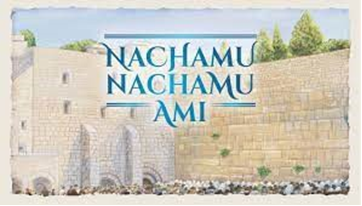
Nachamu: Who Comforts Whom?


Nachamu nachamu ami – Comfort, oh comfort, my people.” (Isaiah 40:1)

After the trauma of Tisha B’Av, God offers solace and consolation. For the next seven weeks, we will read Haftorahs about various elements of what this comfort entails.

I believe these words can also be read as directed towards us. “My nation, you must console each other.” In the aftermath of the destruction of the Temple, an aggrieved nations longs for the embrace of our Father in heaven. At the same time, each of us must find ways to be a source of comfort for those around us. We are to become a nation of consolers.

We know that, in the aftermath of the destruction of the Second Temple, the Jewish reality changed. Ritually, we shifted away from sacrifices towards prayer. Geographically, we moved from the Temple into shuls. Communally, we became more decentralized into individual communities. Rabbi Eliyahu Kramer, the Vilna Gaon, notes that after the destruction, there is a relational and attitudinal shift as well. The Mishnah in Avot (1:2) teaches that the world rests upon three things: Torah, avodah (service), and gemilut chasadim (acts of kindness). The Vilna Gaon says that all three of these are only found during Temple times. After the destruction of the Temple, we don’t have full access to Torah or avodah. Nowadays, all we have is chesed.

Nachamu, nachamu ami – People, comfort each other. Say hello to each other. Smile at each other. Make someone else feel better through words and deeds.

Rabbi Israel of Rizhin (1796-1850) once asked a student how many sections there were in the Shulchan Aruch. The student replied, “Four.” “What,” asked the Rizhiner, “do you know about the fifth section?” “But there is no fifth section,” said the student. “There is,” said the Rizhiner. “It says: always treat a person like a mensch.”

Shabbat Nachamu is a call to comfort and consolation. Yes, we turn to God and await His role in the redemption. At the same time, we have comfort to provide. Each of us can turn to one another with a smile, a friendly greeting, acts of chesed, or just be a mensch.

Friday, August 5, 2022

What Did Kamtza Do Wrong?


Rabbi Yochanan said… Jerusalem was destroyed on account of Kamtza and Bar Kamtza. (Gittin 55b)

We all know the story.

A certain man was hosting a large party. He sent out his servant to deliver invitations – including to his good friend, Kamtza. By mistake, however, the servant brought the invitation to a man named Bar Kamtza, who happened to be on bad terms with the host. (Even back then, the mail was terrible!)

Bar Kamtza, pleasantly surprised with the invitation, attended at the party. The host was aghast and immediately ordered him to leave. Bar Kamtza, not wanting to be embarrassed, offered to reimburse the host for whatever he consumed. The host refused the offer, even as Bar Kamtza offered to pay for half, and then all, of the party. Finally, in front of all the guests, including many respected sages who made no move to intervene, the host physically removed Bar Kamtza from the party.

Angry and humiliated, Bar Kamtza took his revenge by telling the Roman Emperor that the Jewish people were rebelling and that they would reject any offering that the Emperor would send to be brought to the Temple in Jerusalem. When the Emperor sent a calf, Bar Kamtza waylaid it and made a tiny blemish that would make it unacceptable as a sacrifice. The Sages debated what to do and even considered offering the calf anyway to avoid antagonizing the already tense relationship with Rome. In the end, the sacrifice was rejected, the Emperor was insulted, the Temple was destroyed, and the Jews were exiled.

Blame the host. Blame Bar Kamtza. Blame the Sages. But why blame Kamtza?!? He had no idea anything was going on since he never received the invitation. He doesn’t appear in the story!

The explanation is that Rabbi Yochanan isn’t assigning blame to Kamtza and Bar Kamtza. He is describing the destruction of the Temple taking place in an environment in which people feel divided, excluded, disconnected, and alone. Why did the host hate Bar Kamtza so much that he threw him out of the party despite his offer to pay for it? Did Kamtza and Bar Kamtza know each other? Why was Bar Kamtza excluded in the first place? Why didn’t the Sages encourage better behavior? Rabbi Yochanan is describing the sad situation in which people were not friendly, sympathetic, welcoming, and hospitable. Kamtza – like the host, Bar Kamtza, and the Sages – is very much a part of the problem if a society feels so disjointed.

Elie Wiesel recounts the story of the Gerer Rebbe, who asked one of his disciples: “How is Moshe Yaakov doing?” The disciple didn’t know. “What!” shouted the Rebbe. “You don’t know? You pray under the same roof? You study the same book? You serve the same God? You dare tell me that you don’t know how Moshe Yaakov is, whether he needs help or advice or comforting? How can that be?!?”

A society in which people can just “pass each other in the night” without stopping to connect with one another to create a caring community is heading in the wrong direction.

We begin Tisha B’Av with the words “Eicha yashva badad – Alas, the city is lonely…” Kamtza and Bar Kamtza are examples of a society that is torn apart, in which people feel alone. We cannot allow that to exist and must find ways to bring people together. Say hello to an unfamiliar face. Invite somebody new over. Introduce someone new to the Shul.

Destruction is the result of disconnection. Redemption will come from reconnection.